Under Indiana law, counties were required beginning in 1818 to keep a record of their marriages (with some keeping records even before then). Hendricks County was officially formed in 1824, so its marriage records exist from 1824 onward.
In the beginning, marriage records did not contain much information that we as researchers find helpful - just the name of the bride and groom, the date of the marriage, and the name of the person who performed that marriage. The earliest marriage books contained only handwritten entries (pictured: an example from 1839).
By the 1850's, the county began using books that had pre-printed forms (pictured: an example from 1852), which helped standardize the presentation of the information.
In the 1860's and 1870's, in addition to the marriage books, there was the (scattered) usage of marriage affidavit books, which sometimes listed the name of a parent or the age of the bride or groom (if they were under 18). Pictured: an example from 1871.
Handwritten notes were sometimes attached to the marriage affidavit form. Pictured: an 1871 note signed by Thomas C. Sheets stating that he gives permission for his daughter Josephine Sheets to marry.
In 1882, the use of marriage affidavit books was replaced by marriage supplement books. They contained numerous columns of additional information on the bride and groom, including how many previous marriages, their occupation, their birthplace, their residence, their age, the names of their parents and where the marriage took place.
In May 1905, a change in Indiana law took effect, which included the use of marriage application books in addition to the marriage license books. These applications had to be filled out for both the bride and groom, and asked several questions of them, including their parents' residences and birthplaces. Pictured: an example of a marriage application from 1914.
In May 1950, Indiana law consolidated the marriage application and marriage license books into one book. Pictured: an example from 1953.
In 1958 a new set of marriage books was used. The application portion of the marriage record now asked for some proof of the bride or groom's birthdate and proof of medical examination (blood test). Pictured: an example from 1958, where both the bride and groom's birthdates were verified by birth certificates.
The couple would receive the completed marriage license after the marriage had been performed. This document often included information that was not listed in the marriage license books - such as the names of the witnesses and where the marriage took place.
Usually you will only find these papers if they were handed down through the family. However, the Plainfield library has a collection of marriage licenses, which were found in the Hendricks County courthouse. The Indiana Room section of their website has an index in progress (pictured).
In the 1930's, the Works Progress Administration (WPA) indexed Hendricks County's marriage license books for 1824 through 1920. That WPA marriage index (pictured) consisted of the name of the bride, the name of the groom, the date of the marriage, and the corresonding book and page number. The WPA marriage index has been converted into a searchable database, available in the Data section of the Hendricks County GenWeb site. NOTE: There are some flaws in the WPA marriage index - it does not include any entries from Book 1 1/2 (which covered 1831-1837), and errors have been found in the names and book and page numbers.
The WPA also did an index of Hendricks County's marriage supplements books for 1882 through 1920. That WPA marriage supplements index (pictured) consisted of the name of the bride or groom, their father's name, their mother's maiden name, their age as of their next birthday, the date of the marriage, and the corresonding book and page number. The WPA marriage supplements index has been converted into a searchable database, available in the Data section of the Hendricks County GenWeb site.
The Hendricks County Clerk's office has Hendricks County's marriage records. They are on the 2nd floor of the Hendricks County courthouse in Danville.
Hendricks County's marriage license books for 1824-1950, marriage affidavits for 1866-1879, marriage supplements for 1885-1906, and marriage applications for May 1905-1947 have been microfilmed. That microfilm is available at the Family History Library and the Indiana State Library. The Plainfield library also has some (but not all) of this microfilm collection - their marriage license books microfilm covers 1824-1925 and their marriage applications microfilm covers May 1905 - January 1922.
The Archives on the Hendricks County Government website includes digital files of the Hendricks County marriage license books for 1824-2003.
The Hendricks County GenWeb site has an index to the Hendricks County marriage license books in their Data section. This searchable index (pictured) includes the names of the bride and groom, their date of marriage and the corresponding book and page number. It is an ongoing project--so far it covers 1824-1848 and 1904-1964.
Showing posts with label Hendricks County Clerk. Show all posts
Saturday, June 12, 2010
Saturday, May 22, 2010
RESEARCH TIP: Probate Records
When Indiana formally became a state in 1816, it did so with a circuit court in each county. That court had jurisdiction for probate cases. Then in 1829, state law provided for the creation of a probate court in each county, separate from the circuit court. These probate courts remained in existence until 1853, when Indiana law replaced them with a Court of Common Pleas in each county. This court was responsible for hearing probate cases, but could also handle divorces, naturalizations, and criminal cases for small infractions.
Courts of Common Pleas existed in Indiana until 1873, and were then abolished. In most counties, the responsiblity for probate cases then reverted back to the circuit courts, where it is unchanged to this day. However, Marion County (Indianapolis), Vanderburgh County (Evansville) and St. Joseph County (South Bend) have established their own probate courts over the years to help with the caseloads.
The most common types of probate cases are estates and guardianships. Estates are about someone who has died (or been declared dead)--the payment of any debts they had and then the distribution of any remaining assets among their legal heirs. Guardianships are often about minors (children under the age of 21) who are legal heirs to an estate, but they can also be about adults, especially if the person has been found to be of an "unsound mind" or "insane," thus legally incapable of managing their own affairs. Like other kinds of court records, probate records are a great way for researchers to prove relationships between people, especially female ancestors who may otherwise be "missing" from records.
There are different kinds of probate records:
Probate Order Books contain a brief summary written by the court clerk of what happened each time the probate case came to court. Entries in the order books are in chronological order by the court term (with some probate cases continuing for several terms). Pictured: a 1903 entry from a probate order book.
Complete Probate Books contain a summary of the probate case from beginning to end, as written by the court clerk. This summary was made only after the case was finished and was done for an additional court fee.
Probate Packets—also known as “loose papers,” they contain the original documents that were submitted to the court during the probate case—IOUs, receipts, affidavits, newspaper notices, etc. Pictured: a probate packet from 1844.
The Hendricks County Clerk's office has a Microfilm Department, located on the ground floor of the Hendricks County courthouse in Danville (next door to the Self-Service Legal Center--take the west entrance to the courthouse and then turn left). It has microfiche of Hendricks County court records (including probate packets) from the 1900's.
The Microfilm Department has an index to the microfiche on a card file, which they will search for you. NOTE: After the court records were put on microfiche, the papers were destroyed. Unfortunately, the images on the microfiche are not always clear. Pictured: an administrator's application from a 1924 estate case.
Hendricks County's probate packets for 1824 through the early 1900's are kept in the basement of the Hendricks County courthouse. The Indiana Genealogical Society has a project where volunteers are unfolding and organizing these papers, then digitizing them so they can eventually be put online as a free database for the public. The project is in progress--currently there are digital files for about 100 cases.
Hendricks County's Probate Order Books for 1825-1918 and Complete Probate Books for 1826-1905 have been microfilmed. That microfilm is available at the Family History Library, the Indiana State Library and also at the Plainfield library.
NOTE: Hendricks County's probate order books were numbered beginning with volume 1 in 1825, but when the Court of Common Pleas was created in 1853, that numbering started over again. So it's important to know not only the volume number, but what time period it referred to. For example, volume 1 covers 1825 to 1835, and volume 2 covers 1835 to 1839, but then there is the volume 1 that covers 1853 to 1856, the volume 2 that covers 1856 to 1860, etc.
The Archives on the Hendricks County Government website includes digital files of the probate order books for 1825-1847 and a partial file of the order book for 1850-1852. They are in the Judicial Archive section. Pictured: a page from an order book for 1839.
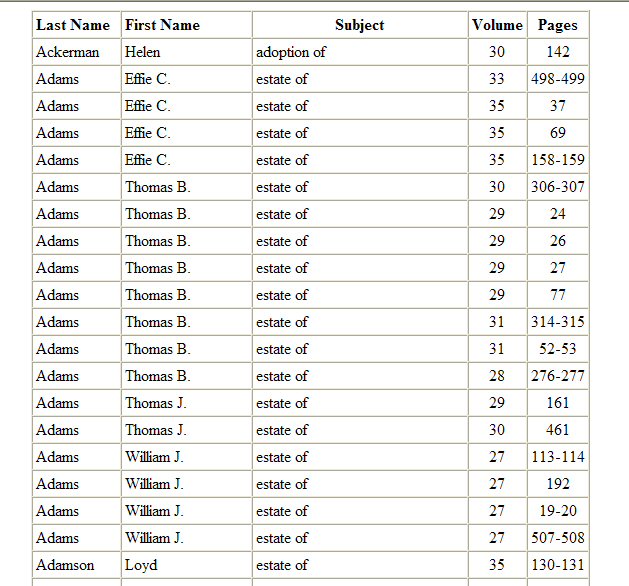
Many of the probate order books have an index at the front (see example). These indexes are separated by the letter of the last name but are not alphabetical--entries were made in the index at the time that the case went to court, so you may need to browse through all the entries under that letter in order to find the case you need.
The Hendricks County GenWeb site has a searchable Index to Hendricks County Probate Order Books. The index is in progress; it currently covers the volumes for 1825-1844 and 1900-1918.
Courts of Common Pleas existed in Indiana until 1873, and were then abolished. In most counties, the responsiblity for probate cases then reverted back to the circuit courts, where it is unchanged to this day. However, Marion County (Indianapolis), Vanderburgh County (Evansville) and St. Joseph County (South Bend) have established their own probate courts over the years to help with the caseloads.
The most common types of probate cases are estates and guardianships. Estates are about someone who has died (or been declared dead)--the payment of any debts they had and then the distribution of any remaining assets among their legal heirs. Guardianships are often about minors (children under the age of 21) who are legal heirs to an estate, but they can also be about adults, especially if the person has been found to be of an "unsound mind" or "insane," thus legally incapable of managing their own affairs. Like other kinds of court records, probate records are a great way for researchers to prove relationships between people, especially female ancestors who may otherwise be "missing" from records.
There are different kinds of probate records:
Probate Order Books contain a brief summary written by the court clerk of what happened each time the probate case came to court. Entries in the order books are in chronological order by the court term (with some probate cases continuing for several terms). Pictured: a 1903 entry from a probate order book.
Complete Probate Books contain a summary of the probate case from beginning to end, as written by the court clerk. This summary was made only after the case was finished and was done for an additional court fee.
Probate Packets—also known as “loose papers,” they contain the original documents that were submitted to the court during the probate case—IOUs, receipts, affidavits, newspaper notices, etc. Pictured: a probate packet from 1844.
The Hendricks County Clerk's office has a Microfilm Department, located on the ground floor of the Hendricks County courthouse in Danville (next door to the Self-Service Legal Center--take the west entrance to the courthouse and then turn left). It has microfiche of Hendricks County court records (including probate packets) from the 1900's.
The Microfilm Department has an index to the microfiche on a card file, which they will search for you. NOTE: After the court records were put on microfiche, the papers were destroyed. Unfortunately, the images on the microfiche are not always clear. Pictured: an administrator's application from a 1924 estate case.
Hendricks County's probate packets for 1824 through the early 1900's are kept in the basement of the Hendricks County courthouse. The Indiana Genealogical Society has a project where volunteers are unfolding and organizing these papers, then digitizing them so they can eventually be put online as a free database for the public. The project is in progress--currently there are digital files for about 100 cases.
Hendricks County's Probate Order Books for 1825-1918 and Complete Probate Books for 1826-1905 have been microfilmed. That microfilm is available at the Family History Library, the Indiana State Library and also at the Plainfield library.
NOTE: Hendricks County's probate order books were numbered beginning with volume 1 in 1825, but when the Court of Common Pleas was created in 1853, that numbering started over again. So it's important to know not only the volume number, but what time period it referred to. For example, volume 1 covers 1825 to 1835, and volume 2 covers 1835 to 1839, but then there is the volume 1 that covers 1853 to 1856, the volume 2 that covers 1856 to 1860, etc.
The Archives on the Hendricks County Government website includes digital files of the probate order books for 1825-1847 and a partial file of the order book for 1850-1852. They are in the Judicial Archive section. Pictured: a page from an order book for 1839.
Many of the probate order books have an index at the front (see example). These indexes are separated by the letter of the last name but are not alphabetical--entries were made in the index at the time that the case went to court, so you may need to browse through all the entries under that letter in order to find the case you need.
The Hendricks County GenWeb site has a searchable Index to Hendricks County Probate Order Books. The index is in progress; it currently covers the volumes for 1825-1844 and 1900-1918.
Saturday, May 15, 2010
RESEARCH TIP: Divorce Records
Divorce may have been more common than we realize. This headline from the November 18, 1909 issue of The Republican, a Danville newspaper, decried the prevalence of divorce. The article was about the results of a 5-year study done by the Census Bureau (at the behest of Congress) to report on the country's marriage rate.
The Census Bureau's report showed that from 1880 to 1900, the U.S. population had increased by 110%, but divorces had increased by 700%. Indiana had a higher ratio of divorce per 10,000 people of marriage age than her neighbors--among the highest in the country, in fact, second only to some of the territories in the West (see illustration).
Hendricks County was not immune to the divorce danger. Each year the county clerk issued a report of how many marriage licenses had been issued vs. how many divorce cases had been filed, and from that compiled a divorce rate. According to the January 4, 1912 issue of The Republican, 134 marriage licenses had been issued the previous year, and 27 divorce suits filed, for a divorce rate of over 20%. The newspaper called the figure "appalling" and blamed the law for allowing a boy to marry at 18 and a girl at 16 if they had their parents' consent--ages when they should just be finishing high school.
At least one Hendricks County judge tried to stem the tide. In the October 12, 1922 issue of The Republican, Judge Zimri E. Dougan (pictured) talked of the need to teach the sanctity of marriage in order to "remedy the divorce evil." He also admitted to slowing down the process of divorce cases that came before him, refusing to hear them until at least 60 days had passed, even though Indiana had no law requiring this. He claimed success, as many of the cases were withdrawn in the interim.
Divorce records can provide you with details of the marriage (including the date, place and the woman's maiden name). If there were any children involved, the records also may give you their full names and birthdates.
At some point, Hendricks County court records from the 1800's (including divorce records) were sent to the Indiana State Archives in Indianapolis. The Archives reportedly did not keep all of these records.
The Hendricks County Clerk's office has a Microfilm Department, located on the ground floor of the Hendricks County courthouse in Danville (next door to the Self-Service Legal Center--take the west entrance to the courthouse). It has Hendricks County court records (including divorce records) from the 1900's.
The Microfilm Department has an index to the microfiche on a card file, which they will search for you (pictured: a divorce petition from 1906). NOTE: The court records were put on microfiche and then the papers were destroyed. Unfortunately, the images on the microfiche are not always clear.
The Republican includes a Court Notes section in each issue, with a summary of the court cases that were on the docket (including divorce cases). The Hendricks County GenWeb site has in its Data section a searchable index to these divorce cases from The Republican--as of this writing, it covers the years 1891 through 1961. The area newspapers also sometimes included items on divorce cases, particularly when they were first filed. The GenWeb site has transcriptions of a few of these newspaper items.
Subscribe to:
Posts (Atom)